Monday, May 28, 2007

Inside the Bush: A Journey into the Mind of The President


President Bush is not an idiot. President Bush is a smart man, surrounded by brilliant advisers. He has a BA from Yale and an MBA from Harvard, and while he was never at the top of his class he was never at the bottom either. The political class had a laughing fit, when, last August, Press Secretary Snow solemnly announced that President Bush had been reading The Stranger. But should that really surprise us?
Read inside accounts from officials who served under Bush and what comes across (even from the disgruntled ones) is a man with a strong grasp of policy. Nor is President Bush, I believe, a zealot. His conversion to evangelism was, while probably not contrived, not nearly as wholesale as we might believe. This is the man who, after all, joked around after his reelection as Texas governor by giving the camera what he called his “one-fingered victory salute.” He, like most mortals, swears in private conversation. (Most famously when a mike caught him cussing with Blair at the G8 summit in St. Petersburg.) Some have even claimed the man may secretly disdain his fellow evangelicals. David Kuo, a former Bush official in the office of faith-based initiatives, wrote in his recent tell all memoir Tempting Faith that “national Christian leaders received hugs and smiles in person and then were dismissed behind their backs and described as ‘ridiculous,’ ‘out of control,’ and just plain ‘goofy.’ The pious, stupid Bush we have grown to know is mostly a construction created by the man himself.
It all began, I think, after President Bush’s unsuccessful 1978 run for Congress. his opponent, Kent Hance, skewered him mercilessly for his fancy degrees and Connecticut pedigree. It was then, I think, that Bush realized that what the American people really value deep down inside is a virtuous cowboy.
But then, who is the real man beneath this persona? Will the real George W. Bush please stand up?
Of course, asking that question begets another question: where is the line separating Bush the man from Bush the icon? With our public figures, the dividing line between personal and political is extraordinarily fuzzy. I doubt very much the man himself realizes much a distinction between the two realms. Unlike superheroes, real celebrities don’t lead a separate life of the alter-ego. In today’s media saturated world, privacy is a meaningless concept for those in the spotlight, and what we get is a persona muddled with a personality until the two are difficult to distinguish.
Still though, trying to unravel Bush is a worthwhile effort. There must have been some point in the man’s life where he decided finally to embark upon a public life. My guess is that it was some point after he realized that business was really not his forte. Perhaps it was during the oil bust of the 80’s. Maybe it was after his less-than-stellar management of the Texas Rangers. The point is that during this key decade, while he languished in obscurity, he saw the success that his father and siblings were having in the political arena.
The effect of Bush Sr. on his son has been often discussed, but this is because it was so tremendous. Imagine George W. trying to eke out an existence in the shadow of the President of the United States. It must have been abysmal. Keep in mind that by the first Bush’s Presidency, George W. was already nearing middle age. And what did he have to show for it? A string of failed businesses. So one factor motivating our friend George W. is probably his father.
However, I do not see George’s subsequent political career as an attempt to mimic his father. If anything, Bush’s career has been a continuation of his entire life: he is the “black sheep” of the family, the rebel. Bush Sr. rose to power banking on pragmatism and expert authority in the bureaucracy, using the CIA as a stepping stone to the vice-Presidency. Bush the Younger has taken an entirely different tack, (after all, he tried his father’s way back in 1978) relying on anti-elitism and personal charm to gain political office. I strongly doubt Bush Sr. would ever have proclaimed a “Jesus Day” in the state of Texas. Or even attempted to run for office in Texas, for that matter.
In the same vein Bush’s ideological rigidity may come less from personal conviction, and more from a desire to be perceived as different from his father. Bush Sr. was a consensus-builder, whereas Junior is a bridge-burner. Bush Sr. was cautious in foreign policy, invading Iraq but then sending the divisions back to Kuwait after the Republican Guard was sufficiently decimated. His son is extraordinarily reckless, invading Afghanistan with essentially nothing but a few special ops teams with air support, hoping (correctly) that the Northern Alliance would use the moment to topple the regime in Kabul. He invaded Iraq with a force far smaller than the one used for a much more limited task in 1991. This risk did not turn out as fortuitously.
Pundits have often tried to determine what President Bush’s ideology is phrases like Compassionate Conservatism have been thrown around. Consider the evidence from his administration. President Bush believes in low-taxes, yet high government spending. He advocates freedom and democracy, but his opponents point to Abu Ghraib, the Patriot Act, suspension of Habeas Corpus, warrantless wiretapping, Guantanamo Bay, and executive signing statements. These are not the acts of an ideologue. They are the acts of one who has no ideology beyond the exercise of power. Bush lowered taxes and increased spending not because of some nonsensical “big government conservatism” but because that is exactly what any politician would do to increase his popularity if he had no regard for long-term consequences. President Bush is a fair-weather friend of freedom because that is exactly what suits him: freedom is good when it serves his purposes but useless when it serves his enemies.
If I had to summarize Bush, I would say that he is a Machiavellian without ends. That is, he does what it takes but what “it” is that he is trying to achieve isn’t entirely clear. Well that is not precisely true. Bush wanted to be great. He wanted to be better than his father. But his problem was that he never filled his role with meaning. What I have compiled here is less a description of what Bush is than what he is not. He is not an idiot, not an ideologue, not a zealot, not a visionary. Americans would be advised to listen to President Bush speak. Ignore his twang, ignore his clumsy handling of the English language. Ignore these things and what becomes apparent is the void, the lack of meaning he conveys with these words somebody else wrote for him. Notice how his expressions never seem to perfectly fit the words coming out of his mouth. Then, try and figure out who is the man behind those expressionless eyes. At that point, it should become apparent why this self-styled moarlistic Texan identified with The Stranger and the absurdist views of it main character.

Tuesday, May 22, 2007

On Second Thought...


Perhpas I was wrong about this being the perfect moment for Gore. There has been some talk of a Nobel Peace Prize for gore this fall, and such a win would, in fact, be the ideal time for him to announce his candidacy.

Saturday, May 05, 2007

A Brief Note


I have been trying not to think about the 2008 election in the "horserace" fashion that is so increasingly common. I've elaborated before on my concerns about the early nature of the contest. The announcement several days ago that Barack Obama is to go under Secret Service protection only increased my concerns. But I cannot help making at least one observation form the stands: Al Gore has a new book coming out this month. It's a little below the radar right now, but my guess is once we start getting closer to the release date of The Assault on Reason the media is not going to be able to help bringing up the buzz around Gore again. Expect to start seeing a lot more publicity around a potential Gore candidacy coming soon. If Gore is planning a run, there's a good chance we may find out in the next month or so. The release of the new book will present a window of opportunity Gore, if he is still interested, (which I am uncertain of) would be foolish to miss, especially considering the pace at which the contest is already accelerating.

Monday, March 26, 2007

The Global Economy v. American Education


The Global Economy, we have been repeatedly told, is upon us. The world is flat, quoth the columnists, and their words soon became holy writ to the disciples of the Church of the Global Market. This newfound geographic conundrum has on occasion, surprise surprise, sent members of the Punditocracy into fits of bloviation on the need of our nation's schools to place a new focus on math and science. This is nothing new. Ever since the launch of Sputnik, that Americans are "falling behind" in math and science has been a common refrain in our nation's political discourse. The United States is always thought to be losing out to its rivals. First the USSR, then Japan, and now China and India. I suspect that once again, we are fixated on a paper tiger. But al the same, it is necessary to address the concerns of the latest round of nervous nellies, because it seems possible that they might actually do some serious damage to our nations education system, and yes, perhaps even our "competitiveness," an elusive term which very few politicos seem to actually grasp the meaning or significance of.
First of all, what are the supposed "threats" we are competing against? Well, the particular concern around this latest round of globalization seems to be that India and China are starting to usurp the jobs not only of easily ignored factory workers far away from where the op-ed rangers of the free trade frontier, but workers in sectors far - how shall I say this? - Closer to home. Yes, India and China have software engineers, and they can work for less money than their United States counterparts.
This begs the question, shouldn't we be pleased if relatively impoverished nations can gain a technological leg up like this? For the sake of argument, assume that this "IT gap" is actually an issue. For the sake of American competitiveness then, what should be done about it?
Well, there are certainly measures that should not be taken. One idea that should never have seen the light of day is that somehow, if we just make our educational standards as rigorous as those of the Asian Tigers, our workers will once-again out compete those of the rest of the world. Well, if I might take a controversial stand: education is overrated, at least the type found in most curriculums. For a society as a whole certainly, education for highly skilled professions is advisable and indeed necessary. But it should also be considered that education only goes so far. Perhaps ten years ago when outsourcing mainly affected more traditional "blue collar" jobs, it could be argued that a degree was the key to success in the modern world. But if the global economy is really the ruthless yet dynamic force that so many claim it to be, then the qualities most valuable in this brave new world are something quite different indeed. Creativity and something of an individualistic streak shall be far more important than any paper diploma in this novo ordo. In this sense, the finest specimens of American public education may produce the students least prepared for the workplace. American high schools are training their students for stability, where the most important attributes include an ability to take standardized exams in a world that will be anything but standard or stable. If we are to truly practice what we preach, it shall require a realization that success in the academy does not translate into success outside. The most successful innovators of the capitalist system have never come out of the ranks of the well behaved, the studious. And in today's world, this is true more than ever.

Sunday, January 14, 2007

It's On

Barely had the new Congress gotten down to business when the exploratory committees began popping up to announce the pseudo-candidacies of many of the individuals who everyone expected to run since 2004. But the process has become so front-loaded that some have questioned whether anyone but an already established candidate can upset the field. Whatever one's feelings about the disproportionately influential Iowa caucuses and New Hampshire primary may be, it is important to acknowledge they did do one important thing: maintain the basic dynamic of the nominating process as it has been since the beginnings of the Jacksonian era. Sometimes a nationally established figure captured the nomination, but often "dark horse" candidates would emerge to steal the candidacy from its heir apparent. But this unpredictability, first created by the convention system, then by early primaries in small states, may be coming to an end. What would it mean if this election actually went exactly as the pundits predict it will? The virtues of the American system is that it gives unknown candidates who may in fact be far more capable of governing than the front-runners a window to overcome their disadvantage in fundraising and publicity. The campaign is very much a trial-by-fire, and rightfully so. Paradoxically, by taking the fate of the free world out of the hands of a few partisans in two small rural states, the Union may be worse-off for it. Sure, it may be undemocratic, but under the circumstances, I think we may soon view the days when men and women with global stature had to trek trough the cornfields and brave the icy winters of New Hampshire with nostalgia.

Saturday, December 23, 2006

The Real Estate Tax Problem

There are several truths about the estate tax that need explanation. The first is that this tax affects less than 2% of the population. The second is that virtually no one, like with the income tax, pays the actual rate delineated by their assets. But there is a problem with the tax. As can be seen below, at the extreme end of the spectrum, taxes as a percentage of assets actually decrease. This, in my view, is the trouble with the Estate Tax. Its greatest purpose, in my mind, is not to generate revenue, but to prevent the formation of an oligarchy in this nation. Those who would lambaste the government for some sort of authoritarianism inherent in taking some of the fortune of the deceased should consider price in freedom society’s pay when too few accumulate too much wealth. Consider the price that Florence paid at the hands of the Medici, or the price Rome paid for the Juliae. If there is anything history teaches us, it is that Republicanism and inherited privilege cannot long coexist.


Wednesday, December 20, 2006

A New Voice

Due to various time constraints placed upon me in the past few weeks, I have been unable to update TQA at a regular frequency. To help me address this problem, and to add a new perspective to the postings, TQA now has a third contributor. The two entries below are both courtesy of nkrosse. As readers may no doubt notice, there are some areas in which our views are something less than equivalent. Occasionally I may offer a repartee to some of his more contentious points. This should be interesting.

Tuesday, December 19, 2006

Letter to New Secretary of Defense, Robert Gates

The Hon. Robert M. Gates
Secretary of Defense
1000 Defense Pentagon
Washington, DC
20301-1000

Dear Mr. Secretary:

It came to my attention today that President Bush has asked you to come up with a plan to increase the size of the military. Besides reinstating the draft, which is politically infeasible and contrary to our nation’s ideals concerning freedom of the individual, the only other option that comes to mind is allowing more people to serve by removing or relaxing barriers to enlistment. From my research and understanding, since the War in Iraq began, the US Army has raised the maximum age one is allowed to enlist at, lowered the minimum IQ score one is allowed to enlist with, and looked over the criminal records of enlistees who have committed violent crimes, all while maintaining the ban on homosexuals serving openly in its ranks.

Surely criminals with violent records pose more of a problem in our armed forces than homosexuals who serve openly. Contrary to what many highly ranked military commanders may say, allowing homosexuals to serve openly would not affect the military in a negative way. The Israeli military, which must deal with and combat terrorists and terrorist organizations for nearly every day, allows homosexuals to serve openly and without consequence (to either soldiers or the security of Israel). Any arguments concerning “unit cohesion” are not only absurd, but also harmful.

It has been noted by many that the “Don’t Ask, Don’t Tell, Don’t Pursue, Don’t Harass” policy, in forcing service members who are gay, bisexual, or questioning to keep their status hidden and “live a lie,” is representative of a greater problem in our government, that is a lack of candor. Mr. Secretary, I saw your confirmation hearing before the Senate Armed Services Committee, and my first impression of you was one of great awe and respect for the openness that you showed the committee and to the American public as well. Why would you implicitly ask any of your subordinates to exemplify anything less, especially when they wear the uniform of the greatest military the modern world has seen? Mr. Secretary, I respectfully ask that you recommend to the president in your plan to lift the “Don’t Ask, Don’t Tell” policy and allow all qualified persons to serve in the military without having to keep secret an essential part of their identity.

Sincerely,

Ideas for the Estate Tax

The late, great Milton Friedman once said of our tax system, "We have a system that increasingly taxes work and subsidizes non work." Today, the federal government taxes estates of people who are worth over $2 million at a rate of 55%. Now, I agree with Oliver Wendell Holmes', Jr., sentiment that taxes are the price we pay for civilization, but the way our government taxes those who have led successful lives is imprudent and unfair. The estate tax exists (or should exist) to tax capital accumulation over one's life (i.e. earnings that come from sources that have not been taxed already). It is entirely possible to be worth $2 million at the time of your death and to have accumulated most of that wealth through income, which, I believe, is already taxed at an exorbitant rate (more on that another day). It would be more prudent for Congress to raise the estate tax deduction to $25 million (the point where, today, one begins to earn more money from dividends and capital gains, which are virtually untaxed), and to lower the rate of taxation of estates to one closer to the highest tax bracket on income (which, if I remember correctly, was around 35% in 2006). This solution is, I believe, not only the best for our nation, but also a good compromise between those who wish to completely eliminate the estate tax and those who wish to maintain the current and harmful status quo. Let's hope incoming Ways & Means Chairman Charles Rangel can make this a higher priority in the new Congress than reinstating the draft.

Friday, November 17, 2006

Progress?


It seems that now that the Democrats actually have some power, I can think of nothing to do but criticize them. But I suspect a certain amount of dissension, both ideological and strategic, can actually be beneficial to the party. So bear with me as I once again commence in what seems to be becoming a recurring pattern. On November 8th, I was optimistic about Nancy Pelosi's coming Speakership, but recent events have made me a little apprehensive. There was Pelosi's ill-advised effort to elevate Murtha to the post of majority leader, but there are also less publicized items. Pelosi has the authority to chose the leader of the House Intelligence Committee, and the logical choice for the job is the ranking Democrat, Jane Harman. While Ms. Harman may be more independent than Pelosi would prefer, she is intelligent, hardworking, and a far superior choice than Pelosi's preference. Alcee Hastings, a man who was impeached and removed from a judgeship in 1989 for attempting to secure a $150,000 bribe. Perhaps I am judging the Democrats too fast, but it is precisely because of the fact that a party elected last week already is trying to get officials who are corrupt into leadership roles, and expending political capital in power struggles, that I am a little worried. Of course I am glad the Democrats won. Divided government is a tonic that can help revive Washington when it is mired in corruption and inactivity. After all, liberalism is an ideological, not a partisan, system. Progress does not require absolute control by a single party.

Friday, November 10, 2006

Now What?

Well, the Democrats pulled it off. So the question becomes "what happens now?" Well, there are certainly things the Democrats definitely shouldn't do. There has been talk of replacing Howard Dean on the DNC with Harold Ford, who is coincidentally out of work just recently. Dean's cardinal sin, in the eyes of Rahm Emmanuel and James Carville, appears to be that he dared to try and carry forward his 50 State strategy with a congressional election coming up. As we all know, these congressional elections happen only every other year. The time Dr. Dean should have executed his 50 state strategy is right now, after the elections. Ah, but the race for the White House has begun. I suppose Dr. Dean should have postponed his long term plans until after 2008. Of course, then he should really be starting to recruit candidates for those all-important 2010 midterms. Perhaps it would be most convenient for the DSCC and DCCC if Dean would execute his 50 state strategy on a day in January in 2009 and a day in December of 2012. Because Mr. Emmanuel would really like some of that money being used to build permanent field operations to run high-impact attack ads three election cycles from now.
I fear that the Democrats are going to get the wrong message from these elections. Their victory tends to obscure the fact that the party still has some very serious problems that are going to have to be addressed eventually. This victory was decidedly not an affirmation of their ideology, or their organizational skills. But this election has brought encouraging signs. The Democrats have what can now veritably be called the big-tent party. Many commentators have misunderstood the results of this election. It is not that more moderate Democrats were elected (although many were) than it is that a larger variety of Democrats were elected. The challenge for the leadership is going to be keeping the party unified after an election when Bob Casey and Jon Tester ran and won under the same party. But this is what all political majorities must do. If the Democrats want to keep their majorities for the long term, it is important that they keep the very different types of people who voted for them unified in pursuit of common goals. When the Republican coalition lost this degree of unity, they lost their majority. The Democrats have been primarily united by a dislike of incompetence and corruption in the Republican Congress and White House. But these factors aren't long term unifiers for the party. Another unifying force is going to have to replace dislike of a nonexistent Republican majority, and soon.

Tuesday, October 31, 2006

Eyes on 2006: State Legislature Edition

I often reprimand pundits for focusing on big-name races to the exclusion of all of the many other complicated elements of politics. So it would be hypocritical of me to do a series on a short-term event (when I have said that is precisely what we do not need to focus on) without taking a look at the one area that may have the longest lasting impact on our nation. Most people's contact with this part of government is quite limited. We see the candidates lawn signs in median strips on the road and think to ourselves "who is that guy again?" Let me be clear: State legislatures may be unglamorous, but they are very, very important. The states, after all, have great powers, and the legislature is usually the most important organ of the state government. Remember the 2002 Texas redistricting debacle? Well, it never could have occurred had the Republicans not taken control of the state house for the first time since reconstruction. Should the Democrats come a handful of seats short of retaking the House this November, you can thank the 30% or so of Texas voters who bothered to show up and vote in an "unimportant" local contest in 2002. In two years time we have a Presidential election. States have extraordinary powers in determining election procedures, and even who is enfranchised, in their state. It is difficult to predict what will happen in elections for 99 separate state bodies. (Nebraska has a unicameral legislature) There are no polls to look to, after all. But my hope is that the Democratic mood permeates down to this level. The future of the country may hang on it.
Update: The Democrats made signficant gains in the state legislature, as in other areas. The Democrats have taken about 275 more seats across the country, and gained control over both houses in four legislatures and one house in four others. I will discuss this more in my first major post-election posting.

Sunday, October 01, 2006

Eyes On 2006: Connecticut Edition

Ah yes. Connecticut. In so many ways, the political conflicts shaping up all over the country are exemplified by the Nutmeg state. There are three races of national significance in Connecticut. The three-way Senate race, the Second Congressional District race, and the Fourth District race. On the surface, Connecticut seems like a state comparable in its liberalism to its neighbor Massachusetts. But despite massive political majorities in the state legislature, and an electorate that reliably goes Democratic in Presidential races, Connecticut voters are deeply independent. Republicans control most of the Congressional seats, and have controlled the Governor's mansion since 1986. Connecticut has only supported the Democratic ticket nationally since the Clinton era. Any recent gains for Democrats in the state have less to do with demographics and more to do with the demise of the moderate wing of the Republican party. If the economic makeup of the state was a good political indicator, it would probably be more Republican than Wyoming. But these Republican moderates are not quite an extinct breed. Jodi Rell, Christopher Shays, and Rob Simmons all continue to hold office in the state of Connecticut. It is Shays and Simmons who may soon become politically extinct. In 2004, Diane Farrell came within 4 points of defeating Shays in one of the wealthiest counties in the United States, and she plans to defeat him this time around. Rob Simmons may be in even more danger than Shays. His seat is considered a "toss-up" by the NRCC. Then, of course, there is the race between Lieberman and Lamont, round two. Oh, there's a Republican also, but he has single-digit support. (Wish Schlesinger the best of luck, by the way. He can only take away votes from Lieberman) While the control of the Senate does not really hinge over this race (Lieberman will probably caucus with the Democrats if he wins) it is in many ways the most important. A Lamont victory will represent a major blow to the Washington establishment of pollsters and pundits that was allowed to call the shots throughout the nineties as the party's infrastructure withered away. That is really what this race should represent in the eyes of the American political class. But Connecticut has never been enthusiastic about party politics, and my bet is that come November, the voters are going to make their decision based on how they judge the personal merits of their Senator, and their Congressmen.

Tuesday, September 12, 2006

Life on September 12th

Last night the President spoke from the Oval Office upon the fifth anniversary of the attacks of September 11th. He took the opportunity to discuss his Iraq war and his particular doctrine of spreading freedom in the Middle East. If President Bush would have simply said this short statement, it would have been an improvement on his 15-minute speech.
Five short years ago, two planes crashed into the World Trade Center. That morning our collective national stupor perished in that towering inferno which claimed so many of our countrymen. Into the void where our illusions used to be came a new feeling: fear. Fear consumes all. It replaces rationality with brashness. Our fear in the days and weeks after September 11th knew no logic. I told Americans that we were in a struggle for survival. I was wrong. There will be other attacks; many more innocents will loose their lives. But even the worst attacks that any group can perpetrate could make even a dent in the strength of the single most powerful society in the history of the world. Only Americans truly posses the power to destroy this new colossus. Our republic shall prevail so long as we ourselves do not relinquish our liberties in the face of terror. The greatest leaders of this nation were never Caesars or Bonapartes. Our great spring from the tradition of Cincinnatus, reluctant in starting war, fierce in fighting it, and rejoicing in peace. Five years after the collapse of our myth of invulnerability, it is time to once again make a choice. Shall we conquer our terror? Or will we allow terror to conquer us?


Thursday, August 31, 2006

Enlightened Self Interest

In what is part of a growing trend across Democratic America, California has once again decided to take advantage of its right to enact policy independent of that of the federal government. The matter at hand is emissions ceilings, specifically the fact that they are not low enough. The old arguments for both sides of the environmental debate were on display as California moved to cut its emission by 25% by 2020. But there was a very strong argument on the side of the environmentalists: the fact that California's water supply depends very much on the rate at which the state's mountain ice-packs vanish in this coming century. California is no stranger to environmental ills. Even the tribes who inhabited the Los Angeles area before the arrival of the missionaries had to deal with smog from their fires being trapped by the mountains which surround the area. So it is somewhat fitting then that California enact some of the most stringent emissions regulations in the nation. And as the old maxim states, "as California goes, so goes the nation." Well, perhaps that is not such an old saying. On the surface this seems ludicrous. California? California can seem so different from the rest of the nation that we forget that it's just ahead of the curve. Culturally this is immediately obvious if you think about it. Fast food, surfing, (and by extension board sports of all types) Hollywood, agribusiness, Disney, megachurches, several different types of music in poor taste, (sorry, but good music mostly comes from the Southeast) highways (actually we got these from Germany) sprawl, strip malls, and, of course, politics. It is that last one that I am concerned with. For the past few decades, California has indeed led the way. Think of Proposition 13, or Proposition 187. The modern conservative movement is based out of Orange County. (And you thought the worst thing they produced was extremely bad television!) The issues that matter in California become the issues that matter for the country in a few years time. That is why I am optimistic about recent trends in the Golden State. Although, to be honest, I think they should have kept Richard Nixon to themselves.

Friday, August 25, 2006

Eyes on 2006: Ohio Edition

As the 2006 elections fast approach, it is time to begin my coverage of the races that may make the difference in November. The first stop is Ohio, a so called "bellwether" in American politics. This year in Ohio, there are two big races, one for the Governorship, and one for the Senate. Governor Bob Taft is not allowed to run again, so the contest will be between Ken Blackwell, the Ohio Secretary of State, and Ted Strickland, a member of the House of Representatives. Ken Blackwell has the dubious honor of being called the Katherine Harris of 2004 for his stringent voter registration requirements which removed thousands of peoples from the voting rolls. (More on Ms. Harris later) Some Democrats have gone so far as to say that Kerry would be in the White House now were it not for Mr. Blackwell. But residual Democratic anger from 2004 is not one of Blackwell's big problems. Instead, Ohio, like much of the nation, is in a fairly anti-Republican mood at the moment. While elsewhere incumbency and unmatched candidates will mean Republicans will hold on to their seats, in this open election between two strong candidates, being a Democrat may be the critical advantage in the race. In the Senate, Mike DeWine is fighting for his political life against Representative Sherrod Brown. Unlike in the race for Governor, DeWine's downfall may come from the conservatives in his own party. DeWine has exhibited something of an independent streak of late. He was one of the 14 Senators who formed the compromise on the Judicial filibuster, incurring the wrath of the Right. I predict that the Democrats will ultimately prevail in both races.

Wednesday, August 23, 2006

Hail Malthus

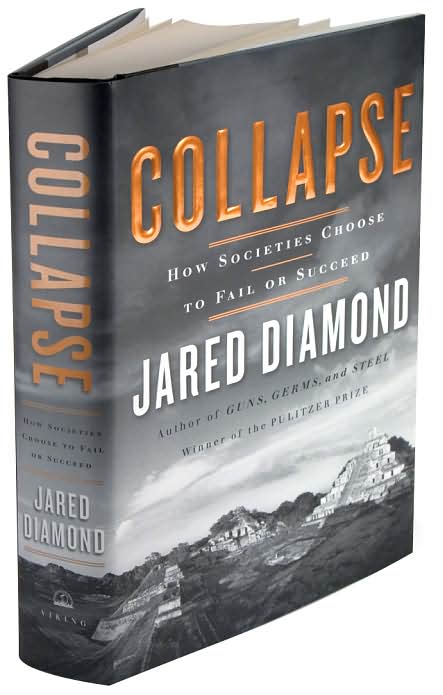
Since the publication of Guns, Germs, and Steel, Jared
Diamond has become one of the nation's foremost public intellectuals. He is probably one of the few people living today who can decide to write "a short history about everyone for the last 13,000 years" and actually pull it off. So when 69-year-old Jared Diamond decides to spend several years of his life writing a massive treatise on the environmental impact of human societies, it is definitely a good idea to pay attention to what he has to say. In this work, Diamond moves closer to the Social Sciences than he ever has before, to the point where he makes some (delicately worded) critiques of the Bush administrations environmental policies. But diamond is, first and foremost, a natural scientist. Interestingly, his science background results in what I think is a very materialist political philosophy. This manifested itself in Collapse's section on the Rwandan Genocide. On the surface, this terrible event resulted from the Hutu's longstanding hatred for the minority Tutsi. But then Diamond brings in a conundrum: an ethnically homogeneous Hutu village where mass killings nevertheless took place. (Note: In this area Diamond is mainly relating the research of other scholars, who he credits in the book) The real culprit in Rwanda? Overpopulation. Diamond shows, quite convincingly, how the increasing population density led to ever smaller plots of land for the farmers of Rwanda, how land became an object of tremendous conflict. This in turn exacerbated strife between those with less (often Hutu) and those with more. (Often Tutsi) Ludicrous, I thought. What about The Netherlands? What about Singapore? I thought Diamond's concern about global population was alarmist, a throwback to concerns about expanding third-world populations a few decades ago. But, in the end, Jared Diamond struck an optimistic tone. He related the story of his visit to the Netherlands, where he was told about a storm surge in the 1950's. It was devastating. The floodwaters killed over 2,000 people of all walks of life. The citizens of the Netherlands realized that they had to work together in order to survive, because the threat of oblivion hangs over all of the citizens of The Netherlands, so matter how rich or powerful they may be. It's a piece of wisdom our own leaders should absorb. For while the powerful do not care when the Lower Ninth Ward floods, they may realize the threat that looms over all civilizations if the waters from the East River enter the UN Security Council chamber.

Tuesday, August 15, 2006

The Curse of Abundance

Something about the recent conflict in Lebanon continues to bother me. In fact, something bothers me about the many conflicts centering around Israel and Lebanon over the last 60 or so years. The problem is that none of these conflicts, not even the present one, have much to do with religion at all. The problem with the current conflicts in the middle east is that the region is cursed with a vital natural resource. Valuable natural resources are one of the worst problems to ever plague the nation-state. Must-have resources from oil to diamonds to opium, bring blood to the land they occupy. It is supposedly a fact of life that with disturbance in the Middle East, oil prices rise. But what if we are reversing cause and effect? Take, for instance, the 1973 OAPEC oil embargo. On the surface, this is a clear instance of cause and effect. The Yom Kippur War was the proximate cause of the embargo, and thus the spike in oil prices. But the root instability in the region, and across the third-world, was due to oil. Facing stagflation, Nixon made the decision to end the gold standard. While this was good for American industry, the value of raw goods produced elsewhere began to depreciate. While the dollar fell, so did the price of oil. The economies of Israel's neighbors suffered, and instability increased. Ergo the Yom Kippur War. I doubt the current conflict could happen without the price of oil where it is at now. Iran fills Hezbollah's coffers with oil money. Ahmedinejad has the audacity to do this because he knows rational Westerners can do little to retaliate without disturbing world oil markets further, and incurring the wrath of Russia and China. Oil is not only haunting the Shiite crescent. Another big supplier, Sudan, has literally been able to get away with murder because of demand for crude. China has (so far, at least) essentially obstructed efforts by the Security Council to take action on the genocide in Darfur because it needs new oil markets. Do we live in an era of religious fanaticism? Perhaps. But surely God is not the cause of oil nearing $80 a barrel.

Tuesday, August 08, 2006

Geeks Unite!


Allow your eyes to wander over to the right side of the screen and a link proclaiming "Save The Internet!" meets your gaze. Yes, I am talking about the principle called Network Neutrality, which has governed the World Wide Web since its inception. Net Neutrality commonly refers to a series of agreements between Internet Service Providers, (often your local phone or cable company) online service providers, and users of the internet. These agreements ensure an equal level of service to all internet users. But a cadre of special interest groups are pushing Congress to abandon the regulations that allow us to use the internet uninhibited. In its first decade of serious use, the government has done a surprisingly good job of keeping the internet free and open. We all know the economic, as well as communication benefits this as given our society. In a time with increased media consolidation, the internet is one of the last figurative n"public squares" open for the general public. To begin offering two tiers of service is a step down a slippery slope, which leads to a world where what we see on the internet is controlled not by us, but by large corporations, much like TV today. Of course, this issue is actually quite complicated, and the motivations of some groups in supporting neutrality are questionable. Still, the fact remains that without it, the internet would be something very different from what most United States citizens have come to rely on daily.

Saturday, July 29, 2006

Well Well....


I am back from my break, and quite a bit has happened while I was gone, it seems. Israel has taken upon itself to launch a war, and Iraq, not to be outdone, has what can fairly be called a real civil war on its hands. But back in the States another civil war has sprung up. It seems to be taking place here in Connecticut! Yes, out here among the Mercedes SUVs and country clubs, (not to mention abject poverty) the battle over the future of the Democratic Party is taking place. It seems that other bloggers have done quite a bit to elevate Mr. Lamont's challenge to the national stage. I was surprised to read that Mr. Lamont's once-Quixotic effort has propelled him slightly over Lieberman in the polls. It now appears that Lamont may actually win the primary. If someone had told me that six months ago, I would have laughed. Which is itself an encouraging sign, regardless of who comes out on top on August 8th. It gives me encouragement that perhaps we aren't doomed to a mediocre Presidential contest in 2008, between candidates who are too afraid to suggest any real ideas. After Bush's 8 years, it will be no time for leadership by sound bite.