Monday, March 24, 2008

A Clever Suggestion


Section One of the 25th amendment states that "[i]n case of the removal of the President from office or of his death or resignation, the Vice President shall become President." The amendment resolved once and for all the ambiguities present in Article II regarding Presidential succession. The Vice President assumes the Presidency, with its attendant powers and responsibilities, in the event that the President becomes unwilling or unable to serve. Based on these words, constitutional scholar Akhil Reed Amar has recently put a new twist into our discussions of a co-Presidency. In The Resident Historian’s recent post on the topic, I pointed out that a co-Presidency would probably not be equitable just because two people can’t really occupy the position Constitutionally. Well, not exactly, if we listen to Amar’s logic. Two individuals could, in effect, “take turns” at being President. What does this mean. Well, let’s say hypothetically we end up with the team of Obama-Clinton. Halfway through the term, Barack Obama could cede the Presidency to Clinton, occupant of the vice-Presidency for the first half of the term. The two could then hypothetically perform the same game in 2012. There are still many practical roadblocks to such an arrangement and I’m not entirely sure how desirable it would be (that will largely depend on how bloody this contest ends up becoming, I think) but constitutionally, at least, a co-Presidency may be more feasible than at first glance.

Thursday, February 21, 2008

Guest Editorial: Co-Presidency


I know, I know. I just said I would stop writing about the elections. But I got this submission from our occasional contributor, The Resident Historian, and it's really quite interesting.

It was hard to ignore the utterances of ‘co-presidency’ simmering below the surface when Bill Clinton began to supersede his wife’s role in her campaign during the week before the South Carolina primary. This term was indeed used pejoratively, but it seems surprising that it has even resurfaced into our political lexicon at all. The only other time in American history that the thought of a co-presidency held so prominent a role in the collective conscious was when Gerald Ford used it as a pre-condition for joining Reagan’s 1980 ticket. Ford’s assertive demand that he would only run as Vice President if the two could share executive power equally was swiftly brushed aside in a quasi-emasculating withdrawal of the invitation to the ticket. Reagan’s move was clearly justified, considering that the freshly-defeated Ford had no teeth at that point to back up his claim to half of the Oval Office.
But as the Democratic electorate continues to split relatively evenly in these primaries, as party leaders balk at the idea of having the unpopular superdelegates decide the contest, and as the delegate count reveals little hope of a clear resolution in the near future, the idea of a co-presidency may actually have some merit in this electoral season.
Let us indulge the speculation sweet-tooth for the moment and analyze the makeup of this year’s Democratic Party dynamic. Large turnout in early primaries, coupled with continuing disillusionment with the governing establishment, raises hopes for the Democrats’ chances of electoral success this year. Large upswings in minority, youth, and working class participation are good indicators that the party has on its hands a unique chance to redefine itself. And of course, there are the candidates, who together represent the most fundamental change to the actual identity of the Democratic Party. The last time there was this zenith of opportunity was 1932.
Approaches to practice and character being the only definitive differences between the Senators Obama and Clinton, it would seem that the two in joint rule might actually be able to most effectively implement their platforms. For evidence, consider John Tyler’s Administration, effectively supervised by the Secretaries of State, Treasury, and War. Not the most memorable administration, yes, but despite having a politically crippled executive, the collective body was able to just as easy administer the Whig platform.
If agreed upon now, the Democratic Party would have to overhaul any and all plans for the General Election to accommodate this radical change, but it would also mobilize the party, not only early enough to start seriously challenging the GOP, but also to an extent unparalleled in American history. The current satisfaction rates for the two candidates among the party electorate is exceedingly high (ranging between about 70-75%). A Double-Ticket might truly make use out of this energy. It would also catch the GOP completely off guard, as a joint ticket has never before been even tepidly considered.
Yet, there remains the question of executive deadlock, which would be all too easy a prey for the Republicans. What if the co-presidents disagree on, as is most likely, healthcare? The obvious solution would be to add a third candidate. Al Gore has expressed interest in mediating the two candidates before the convention. Perhaps he could mediate their policies as a tri-president. Or, considering Gore’s reluctance to lift a political finger, how about Howard Dean? Both men are top Democratic officials who are highly respected and represent the biggest challenge to traditional Democratic electoral politics. And that kind of change is exactly what is needed to capitalize upon this election.
Another obvious potential critique is that this kind of executive front-loading could result in some kind of Authoritarian Presidential Triumvirate. But again, history shows the rebuttal. As mentioned previous, this year has the potential to be a repeat of the fundamental change that redefined the Democratic Party, and realigned the nation. In 1932, similar charges were levied against FDR for the executive centralization implemented by the New Deal. But FDR’s programs have become the major staple to modern American infrastructure and the Democratic platform. This kind of popular executive action will be the key to Democratic success in November, as highlighted by the current policy disputes between Clinton and Obama.
The only other major argument against the idea is that a multi-body executive branch would decrease the uniform singularity with which that arm of the government works. This is true, but in such a case, the legislative branch, properly redefined, would easily take the governing lead. Parliamentary systems such as Italy or India, for example, may have counter-effective political cultures, but their actual system of legislative action and enforcement is not much less productive than our own. That is not to suggest that Steny Hoyer should become the first Prime Minister of America, but a greater capability to Congress would not be unwelcome by this author.
The idea of a co-presidency or tri-presidency is currently unimaginable, unlikely, and somewhat laughable, and I certainly hope that this nomination is resolved before such an idea becomes tangible. But in this election of boundary-breakers and record-thumpers, one cannot rule out even the most far-fetched of strategies. And in this crazy race, such strategies may even become necessary. Ford thought so.
-The Resident Historian

Tuesday, February 19, 2008

While I Wasn't Paying Attention...


In the last two days, Fidel Castro resigned, Kosovo declared its independence, and Musharraf's party got crushed at the polls. It occurs to me that it may be time for us to let sleeping dogs lie: the Barack Obama Hillary Clinton spat isn't going to be resolved for at least a month, and possibly much, much longer. In light of this, and of the fact that yes, things do happen in the world even during major US elections, I pledge not to write at all on the election until the convention opens in Denver. In fact, I will, as painful as this is to say, refrain from even reading anything about the election save actual results from the contests. I urge you all to join me in paying attention to the rest of the world for a while.

Friday, February 15, 2008

Wisconsin

This article from Slate underscores an important point I should have addressed in my last post: the more we begin to think Obama is inevitable, the bigger the shock will be if and when Hillary Clinton has a strong showing. Since she has convinced everyone she is writing Wisconsin off, a victory there would do wonders for her campaign.

Wednesday, February 13, 2008

Steady Now

Barack Obama did very well last night. His gains among working class voters augur well for the contests to come. He now holds a solid if small lead in the delegate count. This is not inevitability. For the umpteenth time this primary season, we are rushing to judgment. The fundamentals of the campaign do not merit any irrational exuberance on the part of those of us who support Obama. The last seven contests were all uniquely suited to play to his strengths. We have had contests in Louisiana and Washington DC with very high African-American populations. We had Maryland and Virginia, which, in addition to having substantial black populations, also have a large proportion of upscale voters with the highest levels of education. We also had three caucus states, which almost always go for Obama. Not one of these states produced particularly surprising results Through a fluke in the primary calendar, they just happened in quick succession. Obama could defy demographics in Ohio, Pennsylvania, and Texas, but it will be an uphill struggle. The contours of the race are roughly where they were on super Tuesday, the only difference being that Clinton will have to persuade a few more superdelegates to lean her way for victory. This isn’t anywhere close to being over.

Wednesday, January 23, 2008

Dynasticism, Experience, and the 2008 Election


The point has come in the Democratic contest where the only viable choice is the choice between Barack Obama and Hillary Clinton. In the hubbub over this historic election a rather profound and simple fact has been overlooked. Forget any preconceptions that exist about Hillary Clinton, ignore all the differences between the two leading candidates for the nomination and the fact remains that a Hillary Clinton nomination could mean three decades of dynasticism in the American Presidency. There has been no election since 1980 without either a Clinton or Bush on the ballot. And what of that fact? Why does this even matter? Consider this: Bush Jr. and Hillary started their respective presidential bids with incredible institutional backing, financial resources, and support in the polls. This alone should give us pause. George W and Hillary didn’t do anything extraordinary to merit this incredible institutional support. They were not incumbent Presidents or vice-presidents eager to take the mantle. Clinton and Bush are incumbents by virtue only of their last name. Neither would have had a particularly successful political career without this. And this - as the case of George W shows - is dangerous. George W. Bush was truly an untested leader. The word untested has gotten bandied about a lot in this campaign. Bush certainly had experience in the conventional sense, as does Clinton. But Bush was never tested with any real dilemmas or any tough moral decisions to make. As a consequence he came in unprepared to lead. Clinton may go down a similar path. At a recent debate, Clinton and Obama gave what I think were revealing answers about their skills to govern. Clinton framed the job of the President in a way eerily similar to Bush: as a kind of national chief executive perfectly organized and ready for business. Then Barack Obama spoke. He acknowledged that he was not the most organized person in the world. But being organized, he said, is not what the presidency is about. Constitutionally the presidency is not very powerful. The power of the President comes from his ability to inspire the American people. A President’s ability comes not from experience in Washington. Abraham Lincoln had virtually no political experience. What he did have was trial by fire time after time in life. Barack Obama has been tried in life. His experience is not beltway experience, but it is experience of a much more valuable kind. He is a man who, like Lincoln, has found himself. What is most remarkable about Obama is how little his judgment has wavered. He knew, in 2002, that he had to oppose the Iraq War. He has spoken of talking to world leaders the United States is on hostile terms with, without preconditions, in his first year in office. The move was widely regarded as a gaffe by pundits, as a sign of his “inexperience.” But rather than go back on what he said Obama has stuck with his conviction because he knows he is right.
That is the problem with dynasticism. It distorts our perspective. It makes us think of experience as years inside a political bunker rather than judgment forged through a lifetime. Electing Clinton may perpetuate a dangerous pattern at the highest level of our national life. Students of western history should know that dynasties make empires out of republics. Our politics and our government should not be determined by bloodlines in this day and age, particularly when there are individuals like Obama waiting in the wings.

Monday, November 26, 2007

Addendum

The media has begun to pay more attention to the upcoming conference than I would have liked. There was an article dileneating Bush's optimism in the New York Times, several op-eds in publications across the country, and significant coverage on the radio. We'll see how this pans out within the next couple days.

Friday, November 23, 2007

Odd Optimism


You may not have heard this, and you probably don't care, but the time for the lame-duck US administration to hold an Israeli-Palestinian peace conference is once again fast approaching. But this time around, I am cautiously optimistic because, so far at least, no one seems to have noticed. The plan this time around is for talks to begin in Maryland this Tuesday. The news media in the United States is paying little attention. The Iowa caucuses are in little over a month. Meanwhile, in the Middle East, several other crises have been distracting the reactionaries on both sides. The saber-rattling going on between Tehran and Washington comes to mind. While the world’s attention is turned towards Iran, Saudi Arabia and Syria are quietly contemplating participating in the talks. But most importantly, no one has any expectations of success. The few reports on the talks focus on their likelihood of failure There is absolutely no way that anyone could be disappointed with the outcome, so there is no pressure to stage a dramatic break-off, as happened in 2000. The situation in the region seems so dismal at the moment, that the idea of progress seems laughable. Of course things could change. A slow news day leading up to the conference could tank everything. Personally, I’m hoping for Ahmadinejad to throw another fireball sometime this weekend. At any rate the bottom line is this: keep a cautiously optimistic eye towards Annapolis this week.

Wednesday, November 21, 2007

You Should Know Who This Guy Is


David Addington is not the sort of fellow to seek out the limelight. From his perspective, this is definitely a good thing. Unlike Bush’s man Rove and Libby, Addington’s predecessor as Cheney’s Chief of Staff, the media has largely let him do his work in peace. Unlike Rove, and his boss Cheney, the media never constructed the evil advisor narrative for Addington. In fact, they never constructed much of anything around Addington. As a consequence, despite the fact that many of his deeds are more egregious then those of anyone else in the administration, and his power greater than that of most cabinet secretaries, he is under no scrutiny form the administration’s opponents.
Who exactly is Addington? A succinct definition is that he is Cheney’s Cheney. He has been close to the VP since his before his days as Secretary of Defense for the first Bush. During the transition period in 2001, Addington helped set up a single executive office, instead of the traditional and separate office of the VP. More specifically, he is a lawyer specializing in intelligence. Back in 2001, he was the brainchild behind Bush’s executive order establishing military commissions dictated at the discretion of not Congress or the courts, but the Secretary of Defense. And as for Presidential signing statements, who else but David Addington? Addington comes from the counterintuitive school of thought that proposes the President’s power has been in decline for the last several decades, and it is time that his authority be restored. And while his legal views may not make much sense, in the twighlight of the Bush years, with much of the administration discredited or impotent, he is a figure to watch for. At least until January 2009, the Bush vision of security at all costs will prevail. Addington has Cheney’s ear, and Cheney is clearly a man who has the President’s ear. While that may not count for much, it still counts for something.

Friday, October 12, 2007

Albert Gore, Kingmaker?

So the Nobel committee has seen fit to select Gore and the IPCC as winners of this year’s peace prize. And the question in minds ‘cross the land is: will he run?
Probably not.
He doesn’t really seem to want it badly enough to go through the hell that is a 2008 Presidential campaign. (Which is probably a good indication of his sanity) But he now has the ability to, if he choses to do so, exert heavy influence on the primary process. Gore’s prestige among democratic primary voters is probably now greater than that of any other individual, save JFK brought back from the grave. An endorsement of Hillary Clinton would probably mean the effective end to the contest. Throwing his weight behind Obama would effectively turn this contest into a two-way race. The question is, would he? Most likely not just yet. No one has quite forgotten his 2004 Dean endorsement. I doubt he wants a replay of that situation. At the same time though, my guess is that what Gore cares most about nowadays is the environment. If he feels that he ought to endorse a candidate for the sake of the planet, then so he shall. He’s a post-politician now. I think Gore was in the belly of the beast for so long that he’s realized that sometimes, just doing what’s right isn’t a bad idea.

Saturday, October 06, 2007

The Golden Age of Poverty


I wonder if the pundit class, sometime between now and November 2008, will begin to realize how inequality is the driving force behind all the lesser issues on the shopping list of political concerns. From immigration to healthcare to terrorism, the issues of our time arise from extraordinary disparity.
The conventional wisdom was that globalization would allow for the gap between the rich and poor to dwindle, but precisely the opposite has occurred. For the first time in human history, we are all connected, and yet global inequality is greater than it has ever been. Not even in the darkest periods of serfdom could it be said, as a study last year by the World Institute for Development Economics Research found, that an adult in the global top 1% had, on average, 13,000 times the assets of the average member of the bottom 10%. What elites have never been able to do in thousands of years through conquest, coercion, and slavery was done in a few decades thanks to modern technology and trade policies: today’s inequality would boggle the mind of the most oppressive czars, who lived like kings, but never dreamed of living like gods.
We all know the identity of our deities. Names like Gates, Walton, and Murdoch come to mind. Men so wealthy that luxury is an afterthought. Men who, through their fortune, have the ability to define their universe. But then, who are our dispossessed? They are young people, anonymous, who have lost all hope and all fear. The face of my generation is not YouTube or MySpace, rather it is manifested in the images we see of teenage boys throwing a stone at a tank, or young refugees behind a wire fence. It is the dispossessed, products of modern inequality, who will shape most of the issues of the coming years. Because while the global economy features increased inequality, it also features a lack of protection from the effects of it for those of us who were once removed from the poorest of the earth.
Even among the Democrats, there seems to be a feeling that inequality, in its truly global sense, is not our problem. Maybe that position was tenable several decades ago, but no longer. The resentment of the youth who make up the largest part of the underclass was once manageable, but no longer. It has crept to our own shores. The September 11th attacks amply demonstrated that the young and disaffected (with the help of some wealthy Saudis) can wreak more destruction than most conventional militaries. This new generation, from unemployed residents of France’s impoverished suburbs to the children of undocumented workers in California, finds itself in an unprecedented position: they are both powerless and supremely powerful. As a group, they are the poorest and weakest assortment of persons on earth, and yet for this same reason, the rest of the world fears them.
Granted, the young will always be a volatile crowd of characters. It is in the nature of youths to revolt. Upheaval almost always comes from the young. And as Jefferson would say, a little rebellion now and then is a good thing. But I fear that the inequity of the current system has become so inhumane that any correction would be closer to a global version of la Terreur than the daisy chains of 1968. I guess I’m a Burkean at heart. But how, then, should candidates address the specter of inequality? Global disparity is a devilishly complex phenomenon. Dealing with a challenge like inequality makes other policy issues seem relatively simple. Even measuring its precise extent is a daunting task. It would be easy to say that the issue is just structural – make a few adjustments in trade policy and poverty would vanish. But the causes of disparity are far more fundamental. Inequality exists increasingly within nations as well as between them. Look at the supposed successful growth models of China and India. I know that growth in inequality usually accompany economic growth. But if Louis XVI tried to explain that to the mob outside Versailles, I doubt they appreciated the message. To be honest, I don’t think anyone knows the answer to this conundrum. Economic distribution patterns are pretty far out of control by any one government nowadays. The forces at work are too complicated, and too numerous manage with much success. The problem is, who’s to blame? I fear that in their search for an answer, we’ll just find another scapegoat.

Friday, September 21, 2007

A Break With Tradition

I don't normally post links, but this article from The Nation has a spot-on assesment of the Richardson campaign. Granted, Richardson has made his fair share of mistakes in this campaign, the "homosexuality is a choice" incident at the Logo debate comes to mind. His lack of attention to the foreign aid issue is also regrettable. (But what candidate is talking about global imbalances?) But, by and large, it seems to me that Richardson is articulating an effective message, particularly on the war issue. Of course, whether he, or anyone, could overcome the tremendous obstacles still facing the second-tier is another matter. These coming months are going to be decisive.

Wednesday, September 19, 2007

An Brief Update on Craig

It now seems possible that Craig may decide to stick on after all. While I cheer his hesitation to resign over a personal matter, I sincerely hope Craig reconsiders some of his stances on gay rights in light of recent events. I don't care whether he officially comes out of the closet. Deep down, he may still be in denial. But that's his decision, and ideally, none of us should really judge him by it. However, after going through so much humiliation, he surely at least must be able to appreciate the discrimination that so many Americans still face. Should Craig manage to stay in the Senate, there will be a thousand voices ready to cry hypocrisy at his actions. With that warning in mind, I wish Mr. Craig the best of luck in his efforts to complete his term.

Thursday, September 13, 2007

An Exercise in Futility


I did not watch Bush’s address, because his announcement of a 5700 troop reduction has already been revealed. Bush will have his reduction, Congress will do nothing, and the war will continue on regardless of what the President or his Democratic opponents say tonight. I also know that the US will probably leave Iraq (Kurdistan excepted) within two years, regardless of whoever wins in November, and whatever they are saying now. No candidate will be willing to assume that political liability for very long. Iraq will be weak and dominated by its neighbors, and then another strongman will inevitably emerge. Give the nation a century, their oil will dwindle into insignificance, and Iraq, with some luck, will become more prosperous and democratic. This war is so uncontrollable, so fluid, that no one can change its course. Iraq's anarchy, and the President's stubbornness have combined to produce a situation with a dynamic as alterable as a natural disaster. Iraq will run its bloody course. I only hope that 10 years from now, we have the sense of moral obligation to spend as much on foreign aid to Iraq as we did on their occupation. A paragraph is an insult to a nation we have so wronged, but this war has exhausted the army, the United States, and the world. The time for talk has passed. We will hear a lot of rhetoric in the coming days, but it will only be noise to cover the incredible, insurmountable inertia which has overtaken both parties in Wahsington on this issue.

Sunday, September 02, 2007

Rethinking the Farm Bill


This month, the 2002 Farm Bill is set to expire. Very few pieces of legislation Congress considers this year will have a much larger impact on the basic lives of millions of people. Farm bills are all-encompassing pieces of legislation that dictate virtually every aspect of the government’s policy regarding that most basic of commodities: food. Everything from livestock to food stamps to ethanol is covered in the bill. But perhaps one of the most important questions of all regarding the Farm Bill is that of subsidies. The House version of the bill continues the subsidies with basically the same structure. It is my sincere hope that the Senate realizes the need to make radical reforms to our system of farm aid. As it currently stands, our price-supports system only helps big-time US agribusiness while hurting poor farmers in the United States and around the world. By spending billions annually on subsidies, the United States government encourages overproduction. This glut of agricultural products has to go somewhere, and this somewhere is more often than not a country that really would be better without it. The subsidies in other Westernized nations are usually as bad or worse than those in the US, so these products are mostly going to nations in the developing world. These governments can't afford to dole out billions to support their own farmers, and as a consequence local agriculture often can't compete with imports from wealthy nations. Meanwhile, back in the United States, the family farm is not doing so well either. And while there are many factors contributing to the decline of the small farms, price supports play a big role. In a 2006 article, the Washington Post reported that "between 1989 and 2003, the share of federal payments for those farms jumped from 13 percent to 32 percent while the share going to small and medium-size farms -- those with $250,000 or less in sales -- dropped from 63 percent to 43 percent.... the shift in subsidies to wealthier farmers is helping to fuel this consolidation of farmland. The largest farms' share of agricultural production has climbed from 32 percent to 45 percent while the number for small and medium-size farms has tumbled from 42 percent to 27 percent." Subsidies artificially drive up land value, which makes it even harder for small farms to compete with large-scale operations.
So what changes should be made in the Farm Bill? Well, much in the way the Estate Tax only covers assets above a certain value, price supports should be cut off above a certain benchmark of farm revenue. This would allow some system of support to remain in place for small farms while eliminating one of the government's worst corporate subsidies. It is also much more politically palatable way of reform for politicians worried about their careers. Our agricultural system is an overlooked wonder. Food in this country is cheaper and more plentiful than anywhere else in the world. Let's hope the 2007 Farm Bill is beneficial for the farmers of the United States and the world.

Thursday, August 16, 2007

The Bush Administration's Second Worst Decision Ever


In one respect, the governments of the United States and Iran are similar. These two very different systems share a peculiar feature. When the government takes an outrageous position, or provokes international furor through some action, there is a good chance that the "official line" is far from the consensus opinion of a sovereign state's government. Take yesterday's news that the State department may place Iran's Revolutionary Guard on the list of terrorist organizations. An Iranian might conclude that America's government is irreconcilably hostile to his nation. In fact, he is just witnessesing a ploy for power by a single ideological stratum within the Bush administration. But how would he know? Americans are similarly unable to identify who is truly responsible for any number of international incedents provoked by Iran. Who ordered the capture of British troops in disputed waters several months ago? Ahmedinejad? Unlikely. The Supreme Leader? Who knows? Perhaps just a more radical sect of Iran's armed forces acting independently. But in this latest incident in the three decade long comedy of errors, we can squarely put the blame mainly on Secretary Rice and Vice President Cheney. The two are rightly frustrated with the lack of progress regarding Iran's nuclear program, but they don't seem to understand that they have just made the situation much, much, worse.
The Revolutionary Guard may not be equatable with, say, the Salvation Army, but classifying them as a terrorist organization belies our commitment to take organizations like Al-Qaeda seriously. There are serious complaints about the guards activities in Iraq and Afghanistan, but Iran is also playing a constructive role in these two nations. Remember, in both nations the US replaced Sunni regimes that were mostly hostile to Iran. The fundamental pillar on which the concept of terrorism rests is that a terrorist is a criminal, not a soldier. He can be arrested, put on trial, and convicted for his crimes in a a court of law. (Of course, the administration doesn't really seem to understand that either) But a soldier is not a criminal. In a just legal system, one that respects internaitonal law, he is not put on trial for the act of taking up arms for his nation. What signal is the administration trying to send by classifying Iran's armed forces as a criminal organization? How can Iranians of any political stripe, regardless of what they think of the Revolutionary Guards, see it as anything but an affront to their sovereignty? If President Bush is prudent, he will disbause anymore notions of this silliness before it gets out of hand, and we once more go to the brink with Iran.

Tuesday, August 14, 2007

Mayberry Machiavelli: On the Rise and Fall of Karl Rove


Karl Rove is no more. In fact, the idea of Karl Rove has been dead for some time now. There came a time when Rove's hubris and absolute confidence in his own strategies failed to match up with actual results. In 2006, Rove blithely predicted that the GOP would hold on to Congress. If Rove had been right again, his legend would have only grown. But as it was, Rove's confidence now just makes him look clueless. A worthwhile question is whether Rove was ever actually the wizard he has been made out to be. What exactly did Karl Rove accomplish? Looking at Bush's winning Presidential campaign, it seems clear that the answer can only be "not much." Rove delivered two of the narrowest election victories in the history of the United States. His strategy of "polarization" accomplished absolutely nothing for conservatism, and in the long run has only strengthened the hand of the Democratic party. A Bush victory in 2004 was probably better for the Democratic party (though not for the world) than a Bush defeat. After seven years of the "Boy Genius" at work, the Dems are in a much better position than they were when they held the White House. America's political discourse, on issues from health care to the environment to gay rights to defense, has moved substantially to the left in these past seven years. A March poll from the Pew Research Center showed that 50 per cent of Americans identify as Democrats while only 35 per cent say they are Republican. A June NBC-Wall Street Journal poll showed 52 per cent of Americans would prefer a Democratic president while only 31 per cent would support a Republican, the largest gap in the 20-year history of the survey. Of course, we shouldn't give Deputy Chief of Staff Rove more credit than he is due. Putting American Conservatism in disarray was a job that could have only been accomplished by a good team effort. So to all of you out there, from the neocons to the theocrats, who showed the USA the wonders of governance form the right, I would just like to send out a heartfelt thank you.

Tuesday, August 07, 2007

A Return of the Caliphs?

Guest Piece by The Resident Historian
It's been relatively quiet in the Middle East this summer (apart from Iraq, that is). However, the peace is very tenuous and indeed violence could re-erupt at the drop of a hat, just like last summer. I think it crucial, then, to offer this as an idea for the future of that troubled region.

Many academics and religious groups in the Muslim world have called for the restoration of the ancient caliphs (a word that literally means ‘successor’). The practice began with the election of Abu Bakr to succeed Mohammed after his death and continue to spread Islam.

A modern caliph, a supreme religious authority in Islamic society, holds several key solutions to what observers describe as the "pestilences of Islam". Of particular note, such an authority would be able to unify large portions of the Muslim populace. Not necessarily the whole religion, as that would be a far fetch. However, I don't think it impossible to have, say, a Caliph for the Sunnis, who could denounce, and thereby limit support for, Wahabbi extremists or other similar radical factions. A caliph would also create a single source of legitimate evaluation and representation of the religion. This would promote solidarity and prevent internal disputes from further fracturing Muslim society. And while the idea seems to effuse clerical conservatism, it is probably the best way to mollify the more archaic and inhumane practices of shariah law.

It is important to note that the original caliphs’ successions were either deathbed nominations or contentious confrontations (one resulting in the Sunni-Shiite rift), and the following caliphs ruled by appointment or hereditary succession. However, seeing as the modern world requires a more representative administration, it would probably be best if the caliphs were elected popularly, or at least by Majiles of assembled Imams. True, this process would be a bit contentious and undoubtedly spark protest groups to splinter from the mainstream, but that would be to their own disadvantage, and the process would still ensure legitimacy for the general, moderate, popular will of the greater Muslim community.

Another point is that the caliphs of old were political heads as well as religious. However, the modern revival must be clear that today’s caliphs are to have religious authority, but no power in any political form. From Othman to the fall of Baghdad to Mongols, caliphs found nothing but trouble in the political arena. The Umayyad dynasty, a group famed for bringing Byzantine administration to a cohesive Muslim community, saw their entire crumble to less than half of Spain because they dared to rule like “kings instead of caliphs”.
The idea is shaky, but doable if pursued correctly, and the yields could be tremendous along the line of Middle East Peace. Only with legitimate authority can the fringe groups of Muslim society be reigned in and can the open culture that once flourished under caliphate rule reemerge in modern times. A good man for this kind of duty might be King Abdullah II of Jordan – an enlightened, open-minded man who is beloved by Muslims and adored by Western leaders. But the time for this form of action is running out. Who knows how long this peace will last?

Sunday, July 01, 2007

Updates

I will most likely be incommunicado until the 26th or so due to traveling. For updates on my travels and other topics, tune in later. This past week I have been in the UK, and politically, it has certainly been an interesting one. On my first day here, (the 27th of June) Blair resigned from Parliament and Brown became the new PM. In the ensuing days, two car bombs were discovered in central London, and, in what seem to be a connected incident, a blazing car was driven into an airport tunnel in Glasgow. Afterwards, another car bomb was found outside the hospital where the driver of the Glasgow vehicle was being held in critical condition. Already the new Prime Minister is talking about an additional expansion of police powers. Now, it may sometimes seem that in the States, the security/freedom balance has tilted a little too far away from the liberty end of things, but Britain is, well, a whole 'nother country. In a given day in central London, I probably make hundreds of appearances on what is called CCTV. In the US, we have a different name for CCTV, surveillance cameras. And yes, we have them, but at nowhere near UK levels. Vehicles are being randomly stopped and searched on the way to Heathrow, an act that would be out of the question (without probable cause) in the US. And Brown may propose allowing terror-suspect detention for 90-days without charge as part of a new series of draconian measures to try and attempt to crack-down. I suppose the Brits do have an excuse. My off the cuff impression at least is that Britain is far more dangerous than the States. We have a nice big country guarded by two huge moats. Getting into this country from overseas is not easy, especially after 9/11. Also, Britain, and Europe in general, seems to have much more trouble with its immigrant relations. We certainly have our fair share of troubles, but in Europe, immigration is this new sort of phenomenon in societies with millenia of history. Naturally, some people are going to have trouble getting along with one another. As Donald Rumsfeld would say, stuff happens. On the other hand, the British do have a much more sensible attitude towards terror. After all, they have much more epxerience with people hating them then we have. After all, the first fanatic who wanted to blow things in this country up was Guy Fawkes, and that was over 400 years ago for God's sake! No one here is going to go bonkers over a couple car-bombs. If the United States ends up playing Bush's imperator fantasy for a few more centures, maybe we can develop a similar attitude. Hey, always look on the bright side!

Wednesday, June 20, 2007

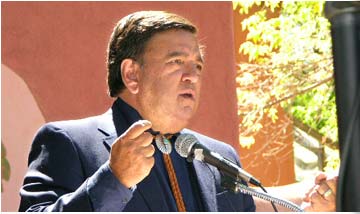
20 Reasons Why We Like Bill Richardson


  1. Bill Richardson is not a Senator. Everyone already knows where this blog stands on the idea of nominating Senators.
  2. He's not from the northeast. Face it, it is very difficult for Northeasterners, especially Democrats, to be successful nationally. On top of that, he is from the nation's fastest growing region. Looking at the electoral college, Richardson could open up a lot of contests that would usually be solidly Republican, especially if the GOP ends up nominating Giuliani or Romney.
  3. He doesn't have a war vote to explain.
  4. He's Hispanic. In 2004, Kerry barely escaped by with the Latino vote. Bill Richardson's support in this key, growing demographic would significantly alter his national averages.
  5. He's personable and pragmatic. He's the sort of guy you might have a beer with. Superficial, yes, but important.
  6. He has experience in Foreign policy.
  7. He actually would get us out of Iraq. Unlike Obama, Clinton, Edwards, Biden, Dodd, he supports full withdrawal within 6 months.
  8. He has been nominated for the Nobel Peace Prize 4 times.
  9. He was our UN Ambassador. Of course, that doesn't mean Bolten would be a good President, but it emphasizes Richardson's worldliness.
  10. He negotiated for the release of many American hostages from Iraq, North Korea, and other hostile nations.
  11. He knows that fighting terrorism includes fighting nuclear proliferation.
  12. He has worked in Congress. .
  13. He has experience in the cabinet as Secretary of Energy. Richardson thus has experience in every capacity in the federal government. Except Judicial I guess. Oh well, no one is perfect.
  14. He has experience as an executive the Governor's mansion. Really, he is an ideal candidate. He hs both an outsider image and vast experience in foreign and domestic policy. Such a combination should not be overlooked.
  15. As Secretary of Energy and Governor of New Mexico, he has made the shift towards requiring more energy to be derived from domestic and green sources.
  16. As Governorof a border state, he has had to deal with the complexities of immigration first hand.He can also speak from the unique point of view of a man who spent a substantial portion of his childhood in Mexico.
  17. He got his state to defeat a constitutional amendment banning gay marriage.
  18. He would close Gitmo.
  19. He legalized medical marijuana for those who are terminally ill.
  20. He can actually ride a horse. Again, image is key. And Bill Richardson, unlike most of the Democrats that have been nominated in the last 30 years, actually has one that could appeal to most Americans.

We know that this is not the obvious choice, but it is the right one.
-Nkrosse and The Quiet American