Five short years ago, two planes crashed into the World Trade Center. That morning our collective national stupor perished in that towering inferno which claimed so many of our countrymen. Into the void where our illusions used to be came a new feeling: fear. Fear consumes all. It replaces rationality with brashness. Our fear in the days and weeks after September 11th knew no logic. I told Americans that we were in a struggle for survival. I was wrong. There will be other attacks; many more innocents will loose their lives. But even the worst attacks that any group can perpetrate could make even a dent in the strength of the single most powerful society in the history of the world. Only Americans truly posses the power to destroy this new colossus. Our republic shall prevail so long as we ourselves do not relinquish our liberties in the face of terror. The greatest leaders of this nation were never Caesars or Bonapartes. Our great spring from the tradition of Cincinnatus, reluctant in starting war, fierce in fighting it, and rejoicing in peace. Five years after the collapse of our myth of invulnerability, it is time to once again make a choice. Shall we conquer our terror? Or will we allow terror to conquer us?
Tuesday, September 12, 2006
Life on September 12th
Last night the President spoke from the Oval Office upon the fifth anniversary of the attacks of September 11th. He took the opportunity to discuss his Iraq war and his particular doctrine of spreading freedom in the Middle East. If President Bush would have simply said this short statement, it would have been an improvement on his 15-minute speech.
Five short years ago, two planes crashed into the World Trade Center. That morning our collective national stupor perished in that towering inferno which claimed so many of our countrymen. Into the void where our illusions used to be came a new feeling: fear. Fear consumes all. It replaces rationality with brashness. Our fear in the days and weeks after September 11th knew no logic. I told Americans that we were in a struggle for survival. I was wrong. There will be other attacks; many more innocents will loose their lives. But even the worst attacks that any group can perpetrate could make even a dent in the strength of the single most powerful society in the history of the world. Only Americans truly posses the power to destroy this new colossus. Our republic shall prevail so long as we ourselves do not relinquish our liberties in the face of terror. The greatest leaders of this nation were never Caesars or Bonapartes. Our great spring from the tradition of Cincinnatus, reluctant in starting war, fierce in fighting it, and rejoicing in peace. Five years after the collapse of our myth of invulnerability, it is time to once again make a choice. Shall we conquer our terror? Or will we allow terror to conquer us?
Thursday, August 31, 2006
Enlightened Self Interest
Friday, August 25, 2006
Eyes on 2006: Ohio Edition
Wednesday, August 23, 2006
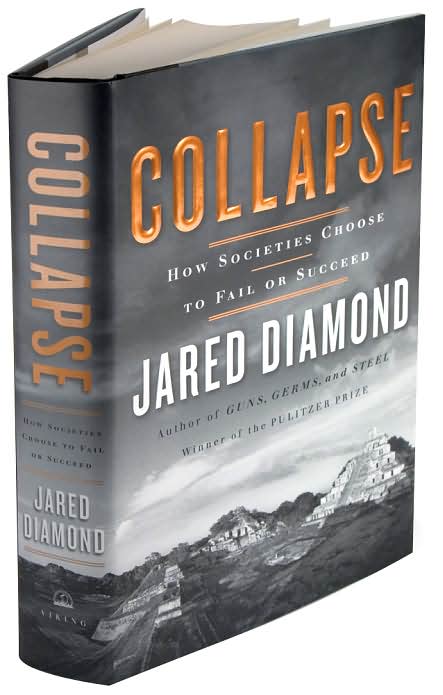
Hail Malthus
Since the publication of Guns, Germs, and Steel,
Jared
Diamond has become one of the nation's foremost public intellectuals. He is probably one of the few people living today who can decide to write "a short history about everyone for the last 13,000 years" and actually pull it off. So when 69-year-old Jared Diamond decides to spend several years of his life writing a massive treatise on the environmental impact of human societies, it is definitely a good idea to pay attention to what he has to say. In this work, Diamond moves closer to the Social Sciences than he ever has before, to the point where he makes some (delicately worded) critiques of the Bush administrations environmental policies. But diamond is, first and foremost, a natural scientist. Interestingly, his science background results in what I think is a very materialist political philosophy. This manifested itself in Collapse's section on the Rwandan Genocide. On the surface, this terrible event resulted from the Hutu's longstanding hatred for the minority Tutsi. But then Diamond brings in a conundrum: an ethnically homogeneous Hutu village where mass killings nevertheless took place. (Note: In this area Diamond is mainly relating the research of other scholars, who he credits in the book) The real culprit in Rwanda? Overpopulation. Diamond shows, quite convincingly, how the increasing population density led to ever smaller plots of land for the farmers of Rwanda, how land became an object of tremendous conflict. This in turn exacerbated strife between those with less (often Hutu) and those with more. (Often Tutsi) Ludicrous, I thought. What about The Netherlands? What about Singapore? I thought Diamond's concern about global population was alarmist, a throwback to concerns about expanding third-world populations a few decades ago. But, in the end, Jared Diamond struck an optimistic tone. He related the story of his visit to the Netherlands, where he was told about a storm surge in the 1950's. It was devastating. The floodwaters killed over 2,000 people of all walks of life. The citizens of the Netherlands realized that they had to work together in order to survive, because the threat of oblivion hangs over all of the citizens of The Netherlands, so matter how rich or powerful they may be. It's a piece of wisdom our own leaders should absorb. For while the powerful do not care when the Lower Ninth Ward floods, they may realize the threat that looms over all civilizations if the waters from the East River enter the UN Security Council chamber.
Tuesday, August 15, 2006
The Curse of Abundance
Tuesday, August 08, 2006
Geeks Unite!
Allow your eyes to wander over to the right side of the screen and a link proclaiming "Save The Internet!" meets your gaze. Yes, I am talking about the principle called Network Neutrality, which has governed the World Wide Web since its inception. Net Neutrality commonly refers to a series of agreements between Internet Service Providers, (often your local phone or cable company) online service providers, and users of the internet. These agreements ensure an equal level of service to all internet users. But a cadre of special interest groups are pushing Congress to abandon the regulations that allow us to use the internet uninhibited. In its first decade of serious use, the government has done a surprisingly good job of keeping the internet free and open. We all know the economic, as well as communication benefits this as given our society. In a time with increased media consolidation, the internet is one of the last figurative n"public squares" open for the general public. To begin offering two tiers of service is a step down a slippery slope, which leads to a world where what we see on the internet is controlled not by us, but by large corporations, much like TV today. Of course, this issue is actually quite complicated, and the motivations of some groups in supporting neutrality are questionable. Still, the fact remains that without it, the internet would be something very different from what most United States citizens have come to rely on daily.
Saturday, July 29, 2006
Well Well....
I am back from my break, and quite a bit has happened while I was gone, it seems. Israel has taken upon itself to launch a war, and Iraq, not to be outdone, has what can fairly be called a real civil war on its hands. But back in the States another civil war has sprung up. It seems to be taking place here in Connecticut! Yes, out here among the Mercedes SUVs and country clubs, (not to mention abject poverty) the battle over the future of the Democratic Party is taking place. It seems that other bloggers have done quite a bit to elevate Mr. Lamont's challenge to the national stage. I was surprised to read that Mr. Lamont's once-Quixotic effort has propelled him slightly over Lieberman in the polls. It now appears that Lamont may actually win the primary. If someone had told me that six months ago, I would have laughed. Which is itself an encouraging sign, regardless of who comes out on top on August 8th. It gives me encouragement that perhaps we aren't doomed to a mediocre Presidential contest in 2008, between candidates who are too afraid to suggest any real ideas. After Bush's 8 years, it will be no time for leadership by sound bite.
Tuesday, June 27, 2006
A Break
Tuesday, June 13, 2006
Who Needs Florida Anyway?
A reader has recently brought a (non-scientific) article
to my attention criticizing Al Gore's new film An Inconvenient Truth. Perhaps Mr. Shepard (who has no connection I can see to the scientific community) should see the movie himself. Most previews don't do the real thing justice, especially if the real thing is more like a power point presentation than an action-packed thriller. To his credit, Shepard does not deny the fact that temperatures are increasing. Yet he does misrepresent the scientific community. Virtually no scientist contradicts the consensus on global warming. Out of over 900 scientific papers in 2004 on global warming, none opposed the consensus view. The 2001 IPPC report declared that "most of the warming over the last 50 years is attributable to human activities." The article also goes so far as to question Gore's images of the snows of Killimajaro, because the melting began in the mid 19th century, before SUVs, we are told. Of course, the mid-19th century was also a time when entire cities in England were covered in coal soot. And yes, there are natural cycles of the presence of Carbon in the atmosphere, but as the chart to the right shows, our levels are unprecedented for even the hottest times in the history of the world. You see the little dip between 20,000 and 10,000 years ago? Look hard, because that was the last ice age. There are a few comparable spots in history dispersed over millions of years where climate change has been so dramatic. All periods of mass-extinction, of course. And yes, the handful of scientists who question this consensus have gotten flack for being in the pocket of big oil. This is mostly because it is true, with the exception of Richard Lindzen, who really just doubts our ability to accurately predict the net effect of future increases in Carbon levels. And there is disagreement over how much the earths temperature will change, but even the most conservative estimate (2 degrees Celsius over the next century) would have dramatic repercussions for the earth. Of course, An Inconvenient Truth is much more convincing than I ever could be. It is highly recommended, even for you, Shepard.
Saturday, June 03, 2006
President... Al Gore?
Buzz has been steadily building over a prospect that a few short months ago I would view as unthinkable. That’s right, the growing clamor for former VP Al Gore to make a White House bid. On the surface it is unbelievable that New York magazine could feature a massive photo of Mr. Gore with the title “The Un-Hillary?” This appears preposterous when one considers the fact that Gore routinely underperforms Clinton in polls against possible GOP contenders and electability meters. But see his new movie An Inconvenient Truth, and the reasons for the hubbub become apparent. I think Gore’s long absence from the world of expensive consultants and vacuous slogans has done the man some good. He speaks with passion and humor, and he even looks better. And most importantly, he inspired genuine enthusiasm among my fellow viewers. This is a rare thing indeed among democrats. And I would be a hypocrite to exclude Mr. Gore solely because of a few poor ratings. After all, this author has stated in the past that a noble yet hopeless crusade may be just what the party needs.
Tuesday, May 16, 2006
President Bush's address
President bush has just announced a plan to send national guard troops to the US-Mexico border."I-In Mexico, there are lots of... Mexicans. And Mexicans, they isn't Amuricans, beause... only Amuricans can be Amuricans... otherwise they're not Amuricans, they're Mexican, or Russian, or, or Italiish. Or is it Italican? Shucks, I can't remember now. Anyway, the point I;m trying to make is that Mexicans ain't Amuricans. They don't even speak Amurican! They speak Mexican! Now, I'm not saying the-there;s anythin' wrong with the Mexiquats... I love Mexicanian culture, I- I'm a big fan of... burrrritoes. (That's called rolling your rr's, an important part of the Mexicali language) And -and quesadillers... . But mainly Dos Equis. Boy do I love that Dos Equis! As they say in Mexicania, "me liko." Of course, after the whole "llama incident" Laura doesn't let me drink anymore. Heh heh heh."Later, Homeland Secretary Secretary Michael Chertoff was asked about the plan."Some have claimed that putting 6000 troops isn't going to change anything along a 1200 mile border. These traitors also point out that if you really wanted to come here you could hop on a boat, travel a couple miles and land write next to Joe's Crab Shack at Laguna Beach. These people are idiots. Look, I am the Secretary of Homeland Security. It is my job! Look, I know there's only 6,000, but we're giving them binoculars. This means that they can see further. We also invented an "immigrant trap." We place a fish taco or other delicious example of the Mexican cuisine out in the middle of the desert, but it causes a trap to fall on the immigrant until an INS official can extract him! See you guys? We will think of anything that doesn't work. I meant everything that does work. What I'm trying to say is that we're thinking, and thinking is good. Look, don't you think I know what I'm doing? Briefing is over, no further questions."
Tuesday, May 09, 2006
Democratic Renaissance?
It is increasingly suggested amongst political philosophic (particularly aligned to leftist policies) that the Democratic Party has strayed much too far to the right to be more appealing electorally - at the expense of its general values. In fact, some would go so far as to say that the Democratic politicians of late have alienated many of their leftist constituents to a breaking point. One thing is clear: the Democrats need to reassess, if not completely reinvent their political agenda and ideals. But how to do this? One need only refer back to the turn of the previous century. Year - 1896, location - Chicago. The Democratic Primary Convention. From reconstruction, the party had been dominated primarily by the Bourbon Democrats - conservatives and generally, products of the local political machines. Among this crowd was incumbent President Grover Cleveland. However, the issue of currency was on the lips of all: Gold Standard or Silver Fiat? Emerging at the convention was middle-aged William Jennings Bryan, Congressman from Nebraska, who demonstrated his support for Silver with incomparable vigor. Following his immortalised "cross of gold" speech, he solidified the Democratic agenda for silver, and won the hearts of many Silverite Republicans. He not only won the Democratic, but also the Populist nomination. Bryan's 1896 strategy was to appeal to the agricultural staple of America. When the dust settled, he had picked up the entirety of the Agricultural West and South, areas predominantly Republican today. However, this did not win him the presidency, for his Republican Opponent had the backing of big business and thus was able to win the industrial majority areas. What Bryan failed to see was that he needed to appeal not only to the farmers, but the industrial labourers in general in order to win. Only with the support of the general working class can a claimed "Party of the People" hope to achieve its ends."Thus, the Republicans gained the West in following elections, but not without due consequence. Bryan's defiance of the Bourbon Democrats and move of the party to the left began an irreversible Progressive Era, which would hold great prosperity in the years to come. His actions paved the way for the Democratic success stories of Wilson, FDR, Truman, Kennedy, and Johnson. The modern Democratic Party must learn from these great examples of the past and take up the Progressive Stance once again. It will gain them the support of an entire nation. The word 'Democrat' now has many denominations. If the party were to specify itself to one issue in particular, and refocus its ideals, it will accomplish its goals with broader appeal. Though not suggesting another Henry A. Wallace Presidential Candidate, the notion of an Independent Progressive Party would be a clever scheme for the Democrats.
-The Resident Historian
Sunday, April 23, 2006
A Different Approach to Immigration
Monday, April 17, 2006
Effective Management?
Today I introduce a new contributor to TQA. Resident historian Max will scour the pages of history in search of events or trends which our relevant to our own time. Of course, his views may not always represent my own.
If history has anything to teach the masses of political theorists, it is that sustained growth and dominance is only suitable with proper distribution of population over vast territories. As the United States continues to employ its self-granted privileges as the global superpower, it must follow the lessons of past powers, and utilise these lessons to maintain its status of potency. Two primary examples to this objective are the British Empire, and Imperial China. The British Empire is known to have been the largest and among the most effective empires in history. This is mainly because of population distribution. The size of the isles are no larger than the state of Colorado, and yet produced an empire of enormous magnanimity. Why? Basically, it is because of luck and management. The British are extremely lucky to live on the Isles. The location has the densest cache of raw industrial materials of anywhere in the world, comparable only to Germany's Ruhr district. This bounty of resources, in combination with high population density, allowed Great Britain to manipulate and monopolise on industry early on, and get a head start on the Industrial Revolution. This makes it surprising that they were not the first European power to begin colonisation. Britain had very limited success early in the colonial era. They did not even begin to colonise until a century following Columbus, and therefore were left with comparatively small swathes of land. But, this was good for the British. Their industrial might allowed them to expand their military and seize necessary bits of land from other powers. Further still, this lack of land proved good for the British to create a densely populated North American colonial system, which created greater urban/industrial growth. The British colonies were far more advanced and populated by 1750 than all of the other European-American colonies combined. Even following the decline of colonialism, the British Commonwealth is an economic juggernaut due to the early achievements of the British Empire. China is the disaster story of Imperialism. Unlike Britain, China had great resources at their disposal, but all inland, which was not populated enough to capitalise on the boon. China had an immense population, but all located on the agrarian Eastern Seaboard, a trend that even today continues to segregate China into two different worlds. Furthermore, China's immense size made it extremely difficult to govern effectively. Although the Zhou Dynasty brought about Feudalism two thousand years before Charlemagne, it was this decentralisation of a vast territory that brought about the Warring States Period, which made the Zhou Emperor, King of a duchy the size of Connecticut. This is a trend that plagued all of the dynasties from the Shang to the Mongolian Yuan. The last two dynasties, the Ming and the Manchu Qing, did not suffer from decentralisation, only because they were propagated by the Europeans."It is speculated that had the Chinese Emperors not continually tried to spread their ideals to their neighbours (much like the U.S.), China would be just as large in sphere of influence, and hundreds of years ahead in technology. Even today, the problems of China continue. It is a rising power, but only because of the investment of globalizing industries seeing the advantages of Chinese low labour laws. Any businessman will tell you that the Chinese people are successful. The average Chinese labourer will say otherwise. If the United States of America is going to continue to impose its ideals upon the world through military support, it should consider how it was successful in the first place, and what it should do to maintain this success, as it directly relates to the activities of its predecessor, Great Britain, and its possible successor, China.
Friday, March 24, 2006
A New Feature
With this posting I inaugurate a new feature to the blog: The Occasional Review of Books. As the name suggests, I will write about a significant political book from time to time, but by no means on any sort of schedule, and only occasionally. Today, the work in question is Niall Ferguson's Colossus: The Rise and Fall of the American Empire.
If anything is to be said of Ferguson it is that he has a remarkable candor. The man is a unabashed proponent of a liberal empire, and he believes the United States is the only world nation currently able to fill this role. Ferguson seems to have a degree of nostalgia for the bygone days of his nation's empire. In chapters of the book he argues something that for the past few decades has been unthinkable in mainstream thought, that former colonies of the third world would be better off if they were still colonial possessions. Other comments of Ferguson are equally taboo. He essentially advocates for gutting the welfare state to bankroll American neo-Colonialism, but unlike fellow supporters of a militant Pax Americana, Niall Ferguson says what he means and means what he says. A passage that really came as a shocker to my sensibilities was this:
"There is undoubtedly something perplexing about the apparent lack of American combat-effective troops... [I]f one adds together the illegal immigrants, the jobless and the convicts, there is surely ample raw material for a larger American army... Reviving the draft would not be necessarily unpopular, so long as it was properly targeted." (292)
Even Dr. Ferguson realizes in the end however that the United States is unlikely to live up to his image of a great and terrible new imperium. The part where the reader is supposed to be alarmed, the "fall" in the books title, is when Ferguson informs us that Americans simply lack the correct character to invade and subjugate foreign nations. And I am relieved to say that I agree with Niall Ferguson. I for one would much rather see the United States as a sort of benign Santa Claus figure than Darth Vader with an American flag lapel.
Monday, March 20, 2006
Europe's Last Dictatorship
As expected, the recent elections in Belarus were a sham, returning the incumbent President Alexander Lukashenko to office with over 80% of the vote. The problem in Belarus is that it is virtually impossible for the opposition candidates to have an effective campaign at all. The state-owned media gives virtually no coverage to the opposition, and the opposition has been essentially prohibited from campaigning. It is expected that international observers will soon call the election unfair. The international community can not stand by and let this Orwellian shadow of democracy suffice once again for the people of Belarus. It is important that the United States considers punitive action against the government of this nation. Soon we will find out if President Bush truly supports freedom for all peoples everywhere, or if, as the case of Pakistan and other "allies" suggests to many, the United States only supports liberty when it is convenient, not when it is right.
Monday, March 13, 2006
Part Three: One Thousand Little Battles
What I am talking about is actually quite simple, when it boils down to it. Controlling a branch of government can be all well and good, but when we talk about control, who do we mean? The Democratic party? The usual answer is yes, but it is not because we like the neat mascot. No, it is because the party represents liberalism, at least for the time being. This may not always be the case, nor has it been in the past. The Democratic Party is a political instrument, no more, as is the entire system of government by professionals the liberals of the past set up. No, in the future, it is prudent to often bypass the federal government entirely. This is why I urge democrats not to put much faith in 2008. Firstly, because it seems unlikely that any individual from the left side of the isle can capture it. Secondly, when it comes down to it, they wouldn't be able to do a heck of a lot anyway. I can think of only two men who have that special personal power which distinguishes the Great from the mediocre. Men who, in this era of stalemate, could actually be somewhat effective presidents. Neither are Democrats. Great people do come along, but I certainly don't think Hillary Clinton is one of them. At the Federal level, Democrats should mainly act as a stopgap, aligning with more States Rights and Libertarian Republicans to prevent right-wing reactionaries from imposing Federal will on the States and on individuals, whether this entails stopping odious court appointments or repulsive Constitutional amendments. Progress should be made in a thousand little battles, not one large one. It is time for Democrats at the State and local level to take control of their own destinies, whether it be through the State Capitol or the local union.
And as for 2008? Working under the presumption that the Democrats are bound to lose,* 2008 should be a time to go out with a bang, advocating for issues. My own suggestion would be to nominate Russell Feingold, a surefire loser, but a great man, unlike most of the other scumbags in the Senate.
*There is the possibility that they might win. If the Republicans nominate Bill Frist, Jeb Bush, or Newt Gingrich (manna from heaven all three) my pencil sharpener could win.
And as for 2008? Working under the presumption that the Democrats are bound to lose,* 2008 should be a time to go out with a bang, advocating for issues. My own suggestion would be to nominate Russell Feingold, a surefire loser, but a great man, unlike most of the other scumbags in the Senate.
*There is the possibility that they might win. If the Republicans nominate Bill Frist, Jeb Bush, or Newt Gingrich (manna from heaven all three) my pencil sharpener could win.
Monday, March 06, 2006
Part Two: The Quagmire of Freedom
Further indication that Republican gains are transitory and rather small are evident. 1936, the year of Roosevelt landslide re-election, saw a Senate elected with 75 Democrats. By contrast, when Bush eked out a second term by the smallest margin in history, the balance of power after 2004 was shifted from 52 Republicans to a mere 55. To give some context to the events of 2004, consider the history of the past decade. Republicans saw their power continually decimated until 2000, a year which showed almost perfect division within the electorate. The advent of global war allowed the Republican party to gain a small line of support. Now, looking at 2006, it seems as if Republicans small gains may be eroded once again. Party identification has been shifting towards the GOP over the decades, but the Democrats still have a six point lead over Republicans. While the Democrats are unlikely to take Congress, a highly plausible net change of 4 governorships would put a majority of those into Democratic hands. I think it is fair to ask a quite simple question:
What is going on here?
Two adjacent Presidential elections being this close, control of Congress being so narrow for such a sustained period. These are phenomena most pundits have dismissed as mere anomalies.
But what if they're not? Here is a hypothetical: what if Democrats do well in 2006 and congress is back where it was two years ago? What if in 2008 the electoral map is virtually identical to that of 2000 and 2004?
The years after the end of the New Deal Democrat era have seen no major changes in the nature of government. Any bold new initiative has been shot down. Think Clinton's (or Nixon's or the US Congress's in the 70's) health care plan, think Bush's social security scheme. Even Ronald Reagan, probably the most effective President since Johnson, was able to do little more domestically than cut taxes and temporarily reduce domestic spending by a small amount. The last three decades have seen only one Amendment to the US Constitution. (A fairly technical and ineffectual one at that)*
Here is a crazy thought: Americans have become too good at politics. We have done the unprecedented in this nation, turned the exercise of Democracy into a multi-billion dollar industry. Perhaps no single politician or political party can gain enough traction for any long enough period of time to make a sustained impact on society.
What this means is that we are, in fact, fighting a costly yet bloodless trench war in this nation, a quagmire of freedom. In the coming years, should no one party gain control over the goverment, something will have to give.
Yet both parties are preoccupied with fighting the next battle instead of winning the war. We have become stuck in the biennial mindset. I have heard much musing over the coming elections in 2006 and 2008. But what about 2010? What about 2014 or 2018 for that matter? It will take long term thinking to escape from the quagmire of freedom. So, what exactly does this entail? I shall give some examples in my next posting.
*Granted, the purposes of the 27th (preventing Congress from raising its pay between elections)are noble, but in practice the Amendment is often circumvented through "cost of living adjustments."
What is going on here?
Two adjacent Presidential elections being this close, control of Congress being so narrow for such a sustained period. These are phenomena most pundits have dismissed as mere anomalies.
But what if they're not? Here is a hypothetical: what if Democrats do well in 2006 and congress is back where it was two years ago? What if in 2008 the electoral map is virtually identical to that of 2000 and 2004?
The years after the end of the New Deal Democrat era have seen no major changes in the nature of government. Any bold new initiative has been shot down. Think Clinton's (or Nixon's or the US Congress's in the 70's) health care plan, think Bush's social security scheme. Even Ronald Reagan, probably the most effective President since Johnson, was able to do little more domestically than cut taxes and temporarily reduce domestic spending by a small amount. The last three decades have seen only one Amendment to the US Constitution. (A fairly technical and ineffectual one at that)*
Here is a crazy thought: Americans have become too good at politics. We have done the unprecedented in this nation, turned the exercise of Democracy into a multi-billion dollar industry. Perhaps no single politician or political party can gain enough traction for any long enough period of time to make a sustained impact on society.
What this means is that we are, in fact, fighting a costly yet bloodless trench war in this nation, a quagmire of freedom. In the coming years, should no one party gain control over the goverment, something will have to give.
Yet both parties are preoccupied with fighting the next battle instead of winning the war. We have become stuck in the biennial mindset. I have heard much musing over the coming elections in 2006 and 2008. But what about 2010? What about 2014 or 2018 for that matter? It will take long term thinking to escape from the quagmire of freedom. So, what exactly does this entail? I shall give some examples in my next posting.
*Granted, the purposes of the 27th (preventing Congress from raising its pay between elections)are noble, but in practice the Amendment is often circumvented through "cost of living adjustments."
Tuesday, February 28, 2006
A Republican Era? (Part One)
It has now become almost cliche to say that the United States has entered a republican majority political phase. In the past, political scientists have identified 3 or 4 decades of party supremacy followed by a realigning election. A classic example of a realigning election is 1932, the year in which Democrats swept every single (political) branch of federal and state government. Traditionally a realigning election has displayed very clear across-the board change from the local dog catcher to the White House. Before I stated three or four decades, but some claim a more exact figure: 36 years, which seems an impossibly accurate. But the logic is compelling:
1786-1824: Nation's founding to birth of Jacksonian Democracy
1860: The Republicans come to power only four years after their birth as a party, ending Democratic dominance.
1896: McKinley defeats Brian, in an election that changed not the party in power, but the ideological emphasis of both parties.
1932: Rise of the New Deal Democrats
This list is not without controversy. Some consider 1800, for just one example, to be a realigning election. It is important to consider whether realignment is even a legitimate concept at all. These dates may just be artificial benchmarks to give some shape to history. But any disagreements over those debates pale in comparison to the controversy over modern elections. Following the bizarre 36 year pattern, the next realignment date would seem to be 1968, followed by 2004. Indeed, many have suggested that 1968 was such an election. But the supposed Republican backlash that year did not manage to gain control over any part of government besides the Presidency. A good measure of a party's relative power is the five part measurement, looking at not only the Presidency and the two houses of Congress, but the governorships and control of state legislatures. 1980 and 1994 have both been suggested as other possible realigning years, but it was not untill 2002 (excluding a small time in 2001) that the Republicans actually had a majority or control in all five of the bodies of power previously mentioned. When looking through the long view, Republican claims seem less plausuble. The question remains though, what has happened in the last three decades?
-To Be Continued-
1786-1824: Nation's founding to birth of Jacksonian Democracy
1860: The Republicans come to power only four years after their birth as a party, ending Democratic dominance.
1896: McKinley defeats Brian, in an election that changed not the party in power, but the ideological emphasis of both parties.
1932: Rise of the New Deal Democrats
This list is not without controversy. Some consider 1800, for just one example, to be a realigning election. It is important to consider whether realignment is even a legitimate concept at all. These dates may just be artificial benchmarks to give some shape to history. But any disagreements over those debates pale in comparison to the controversy over modern elections. Following the bizarre 36 year pattern, the next realignment date would seem to be 1968, followed by 2004. Indeed, many have suggested that 1968 was such an election. But the supposed Republican backlash that year did not manage to gain control over any part of government besides the Presidency. A good measure of a party's relative power is the five part measurement, looking at not only the Presidency and the two houses of Congress, but the governorships and control of state legislatures. 1980 and 1994 have both been suggested as other possible realigning years, but it was not untill 2002 (excluding a small time in 2001) that the Republicans actually had a majority or control in all five of the bodies of power previously mentioned. When looking through the long view, Republican claims seem less plausuble. The question remains though, what has happened in the last three decades?
-To Be Continued-
Saturday, February 25, 2006
The Thoughts of a Soldier
An American soldier wrote this while stationed at the Abu Ghraib Prison in Iraq. I can not claim to speak for either him or the United States military. I realize that no one individual, be it Donald Rumsfeld or a soldier on the ground can speak for the United States as one voice. I encourage you to consider his reflections.
1) This is not Vietnam. Here, we don't call 'em "gooks" but haji.
2) U.S. Army and Communism
-you wait in line for everything
-they listen to your phone calls
-you're not rewarded based on merit
-it's a hierarchy; it's about who you know
-you're a number
-the system screws you
-you are not trusted, they are not trusted
-freedom of speech is censored.
Zogby has just released a poll of United States military personnel in Iraq. The poll shows that only 23% felt that they should stay "as long as they are needed." Perhaps support for the war is not as uniform in our military as the pundit class would have us believe.
1) This is not Vietnam. Here, we don't call 'em "gooks" but haji.
2) U.S. Army and Communism
-you wait in line for everything
-they listen to your phone calls
-you're not rewarded based on merit
-it's a hierarchy; it's about who you know
-you're a number
-the system screws you
-you are not trusted, they are not trusted
-freedom of speech is censored.
Zogby has just released a poll of United States military personnel in Iraq. The poll shows that only 23% felt that they should stay "as long as they are needed." Perhaps support for the war is not as uniform in our military as the pundit class would have us believe.
Subscribe to:
Posts (Atom)